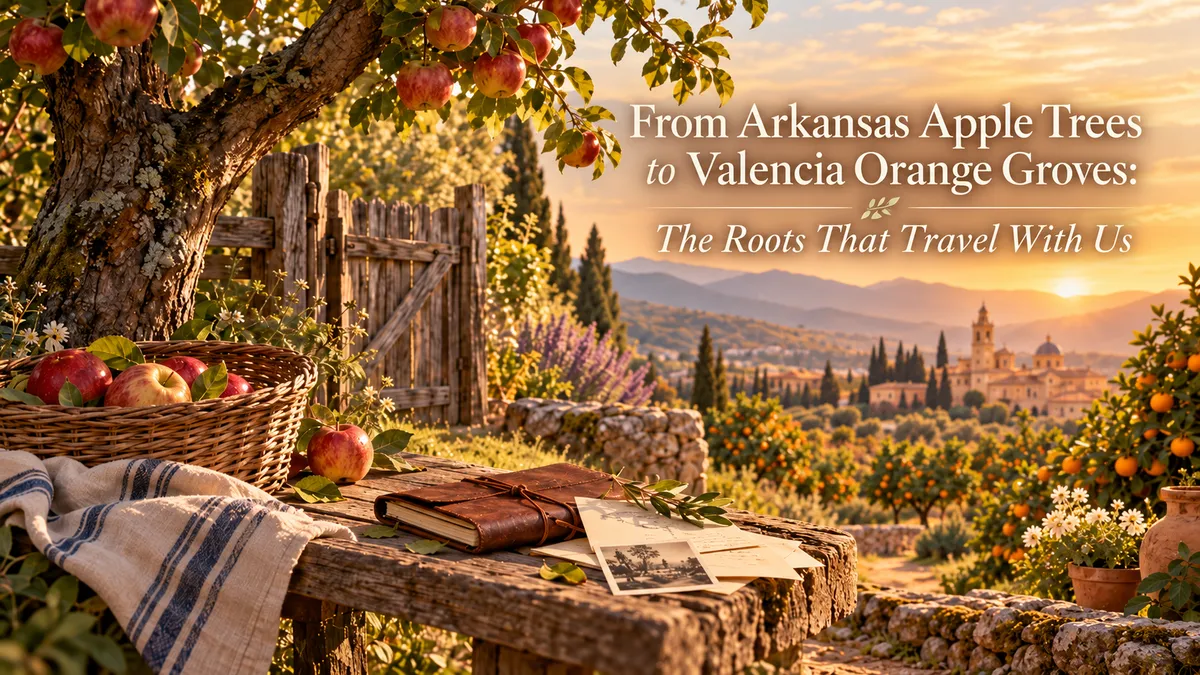
From Arkansas Apple Trees to Valencia Orange Groves: The Roots That Travel With Us
There was an apple tree at the end of my grandparents' garden, standing in the rocky Arkansas soil as though it had made a solemn promise to remain there regardless of what the seasons might bring. It was not a particularly grand tree, and I doubt anyone passing down Frost Lane would have given it a second look. Its branches reached toward the sky with the quiet determination of something that had learned to survive on whatever the land and weather provided. Yet to a little girl growing up on that ranch, the tree was part of a world that felt as dependable as the sunrise. It belonged to the garden, the changing seasons, the familiar sounds of farm life, and the comforting knowledge that Papa and my grandmother were nearby, tending to the responsibilities that made our little corner of Arkansas feel like home.
These days, that old apple tree has been wandering through my thoughts more often than usual, and I believe I know the reason. I am preparing for an international journey to Valencia, Spain, where I will attend a Women's Retreat for Business Planning and Strategy. As I have been reading about this beautiful Mediterranean city, I have become especially fascinated by the orange groves that have helped shape its agricultural history and cultural identity. I find myself imagining rows of green trees dotted with brilliant orange fruit, growing beneath a Spanish sky and nourished by a landscape so different from the one I knew as a child. Somewhere between those images and my memories of the little garden down Frost Lane, I began to recognize a familiar lesson that has followed me for more than seventy years.
A tree does not have to grow in the same soil as another tree to teach the same truths about life. Whether its branches carry Arkansas apples or Valencia oranges, its greatest strength begins in the roots no one can see.
The Apple Tree at the End of the Garden
When I close my eyes and think about my childhood, I can still picture the land surrounding my grandparents' home. The Arkansas hills were beautiful, but they were not always gentle with the people who depended upon them. Rocks seemed to appear wherever someone hoped to plant something, and the soil required a great deal of patience from anyone determined to make it productive. Farming and ranching were not romantic notions in our household. They were part of everyday life, with responsibilities that continued whether the weather was pleasant, someone was tired, or there were other things we would rather have been doing.
My grandfather, Fonie, whom everyone simply knew as Papa, understood that land had to be worked with respect. He knew its stubborn places and its generous ones, and he understood that the best results came from paying attention to what the soil needed rather than demanding that it give us something simply because we wanted it. I remember the gray mare, Bird, and the sight of Papa working behind the horse and plow. There was a steady rhythm to that work, a partnership between man, animal, and earth that required more patience and understanding than most people might imagine.
As a little girl, I did not fully appreciate what I was witnessing. I saw Papa working, the mare moving, and the earth turning beneath the plow. I saw the garden and the apple tree that stood at its end, but I had no way of knowing that those ordinary scenes were teaching me lessons I would carry into classrooms, boardrooms, business ventures, and eventually across an ocean.
The apple tree was not there to impress anyone. It simply occupied its place in the world, enduring the cold of winter, awakening with the warmth of spring, and following the seasons that God had established long before any of us arrived. Some years were surely kinder to it than others, but the tree continued doing what trees are meant to do. It put its energy into growing, holding its place in the soil, and producing fruit when the conditions were right.
I sometimes wonder how many times I passed that tree without recognizing the extraordinary wisdom standing right before me. Children have a remarkable way of accepting the familiar without asking what it means. We assume the people who love us will always be close enough to call, that the houses we know will remain unchanged, and that the trees growing near our homes will be there whenever we return. Only later do we understand that the most ordinary places can become the most treasured landmarks of our memories.
Today, I would give a great deal to walk down that familiar path once more, see the apple tree just as it appeared when I was young, and spend another afternoon watching Papa tend the land. I would ask more questions, listen more carefully, and pay closer attention to the lessons that were being offered so generously without anyone calling them lessons at all.
An Ocean Away, Another Kind of Orchard
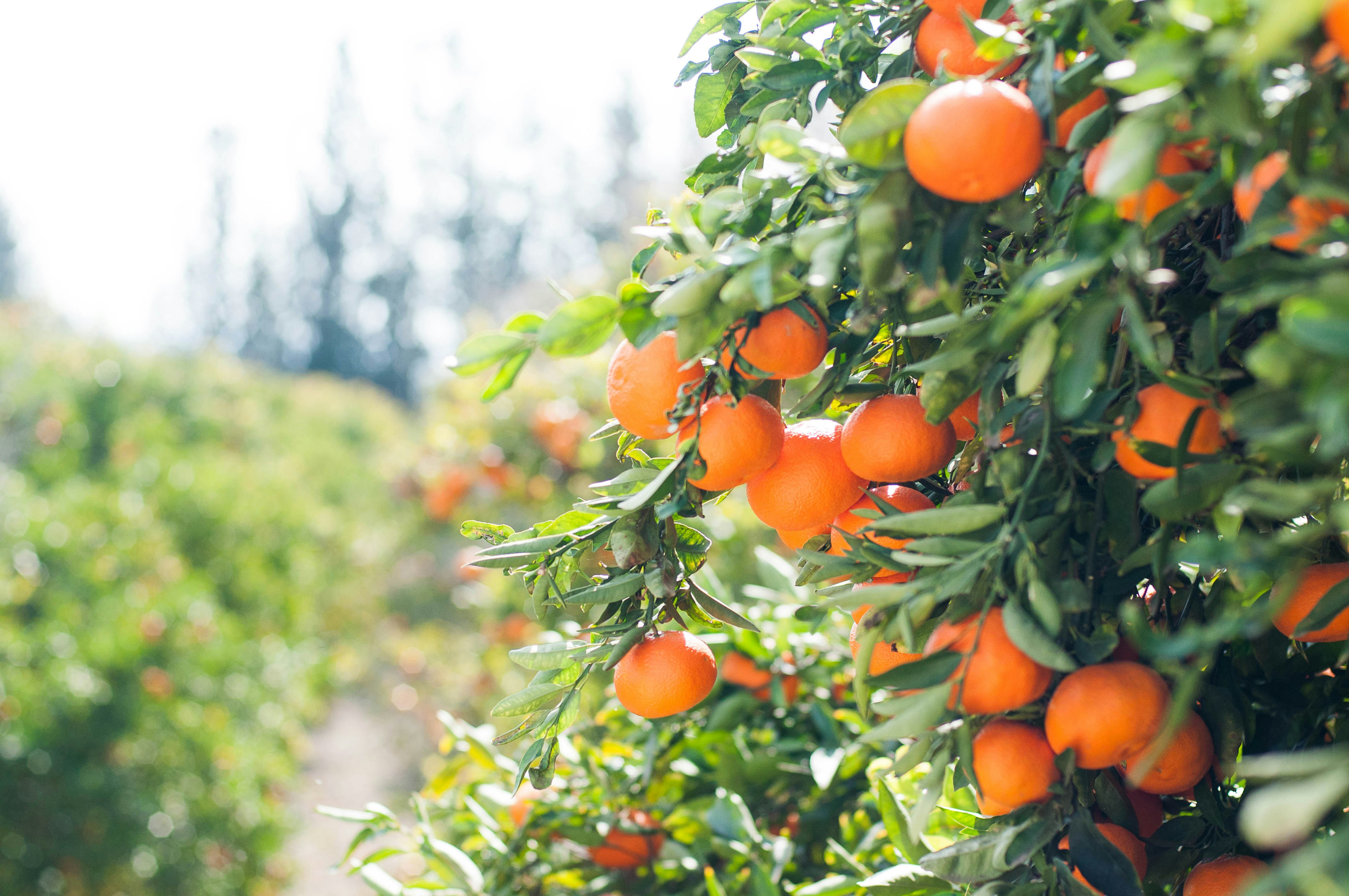
Valencia, Spain, is famous for its oranges, and the more I learn about the region, the more I appreciate the generations of farmers whose work helped make that fruit such an important symbol of the area. The fertile agricultural landscape surrounding the city is known as l'Horta de València, a countryside shaped by centuries of cultivation and an intricate network of irrigation channels that carry water to the fields. The region's farming traditions extend back through many generations, with agricultural techniques refined during centuries of Islamic influence on the Iberian Peninsula.
Although citrus trees have a long history in the region, the large-scale cultivation of sweet oranges developed much later, particularly beginning in the eighteenth century. Over time, orange production became an important part of the Valencian economy, and the fruit that grew in its orchards found its way to markets far beyond Spain. Even today, orange trees remain closely associated with Valencia, appearing not only in agricultural landscapes but also along city streets and public spaces.
I find that history fascinating because it reminds me how much patience is required to build something that will outlive the people who begin it. Those early growers had to understand their land, learn how to care for the trees, manage water, and develop ways to transport their harvest to people who lived far from the orchards. They were doing more than growing fruit. They were establishing traditions, creating livelihoods, and developing knowledge that future generations could build upon.
There is something especially meaningful about the idea of irrigation in a place where water has been carefully managed for centuries. In Arkansas, our challenges often involved rocky soil, unpredictable weather, and the practical demands of tending a working ranch. In Valencia, growers developed sophisticated systems to distribute precious water across fertile fields. The circumstances were different, but the underlying lesson was remarkably similar. The land must be understood before it can be cared for wisely, and those who hope to enjoy its harvest must accept responsibility for its future.
I imagine that if Papa had been able to visit Valencia with me, he would have been interested in more than the beauty of the orange groves. He would have wanted to know about the soil, the irrigation systems, the age of the trees, and the people responsible for tending them. I can almost hear him asking practical questions while I stood nearby admiring the golden fruit and trying to decide which photographs I wanted to take.
And I suspect that after listening to the answers, he would have recognized a kindred spirit in the farmers of Spain. People who make their living from the land may speak different languages and follow different customs, but they understand certain truths that do not require translation. They know that the weather does not always cooperate, that good stewardship requires daily attention, and that the work of one generation often becomes the inheritance of another.
Two Trees, Two Continents, and the Same Lesson About Roots
As I compare the apple tree of my childhood with the orange groves of Valencia, I keep returning to the importance of roots. The apples that grew in Arkansas and the oranges that grow in Spain may look different, taste different, and require different growing conditions, but both depend upon the hidden systems that anchor them to the earth and provide the nourishment necessary for life.
I believe people are much the same.
My roots reach deep into the Arkansas countryside, into the lives of my grandparents, the lessons of our ranch, the family stories that shaped my childhood, and the Cherokee heritage that remains part of who I am. Those roots provided a foundation long before I understood where life might eventually lead me. They taught me to value education, respect hard work, honor family, and recognize that the gifts we receive carry responsibilities extending beyond ourselves.
As the years passed, life carried me into experiences that little girl down Frost Lane could scarcely have imagined. I spent decades in education, earned advanced degrees, became a professor and department leader, built businesses, raised a family, welcomed grandchildren, and discovered new opportunities to speak, write, and mentor women. There were seasons of tremendous joy and accomplishment, but there were also losses that changed the landscape of my life in ways I could never have anticipated.
Through all those experiences, the lessons of home remained with me. They did not prevent disappointment or eliminate difficulty, but they helped me understand how to respond when life required more strength than I thought I possessed.
I have come to believe that strong roots do not require us to remain in the same place forever. In fact, they may be one of the reasons we are able to travel so far. When we know the values that anchor us, we can enter unfamiliar places without feeling that we must abandon who we are. We can appreciate new cultures, learn new skills, form new relationships, and embrace opportunities beyond anything our younger selves might have imagined.
That is part of what makes this upcoming journey to Valencia so special to me. I am not traveling to Spain to become someone entirely different. I am going as the woman those Arkansas roots helped me become, carrying decades of experience and remaining willing to learn something new.
The Fruit of a Life Does Not Always Ripen on Our Schedule
One of the most important lessons I learned from growing up close to the land is that nature operates according to seasons, not human impatience. A farmer may prepare the soil carefully, plant with hope, and tend a crop faithfully, but the harvest still arrives according to conditions that cannot be completely controlled.
The apple tree at the end of our garden understood something about that rhythm. It did not hurry through winter because someone wanted spring to arrive sooner, nor did it produce fruit simply because a little girl might have been impatient for something sweet. Its life followed a process that required time, rest, growth, and renewal.
I think about that lesson often when working with women who are entering new chapters of their lives. Many have spent decades measuring their progress through professional advancement, family milestones, business achievements, and responsibilities successfully completed. They have grown accustomed to calendars filled with deadlines and accomplishments that can be measured, reported, and celebrated.
Then a season arrives when those familiar measures begin to change. Retirement alters the structure of their days, children establish lives of their own, careers become less central, and the roles that once defined their identity begin to shift. Some women welcome that freedom immediately, while others struggle to understand what their lives should look like without the responsibilities that occupied so much of their time.
I want those women to remember what an orchard teaches us. A tree is not finished simply because one harvest has been gathered. There may be another season of fruitfulness ahead, but it may require a different kind of tending and a willingness to trust a process that does not unfold according to yesterday's schedule.
At seventy, I have discovered that some of the most meaningful opportunities of my life are arriving at an age when society sometimes assumes a woman should be winding down. I continue to develop HER Life Legacy™, write, mentor, speak, and explore possibilities that challenge me to keep learning. My upcoming retreat in Spain is another expression of that belief.
I am not trying to recreate the woman I was at thirty or forty. I am learning how to honor the woman I have become and discover what her experience now makes possible.
Perhaps that is the sweetest fruit of all.
What Papa Knew About Stewardship
The word stewardship has become especially meaningful to me in this season of life, although the principle itself was familiar long before I understood how to explain it. Papa demonstrated stewardship through the way he cared for the ranch, tended the animals, worked the soil, and approached the ordinary responsibilities of family life.
To him, ownership was never simply permission to use something however we pleased. It carried an obligation to protect, maintain, and pass forward what had been entrusted to our care. The land belonged to a story larger than any single person, and the decisions made during one lifetime could influence what future generations would inherit.
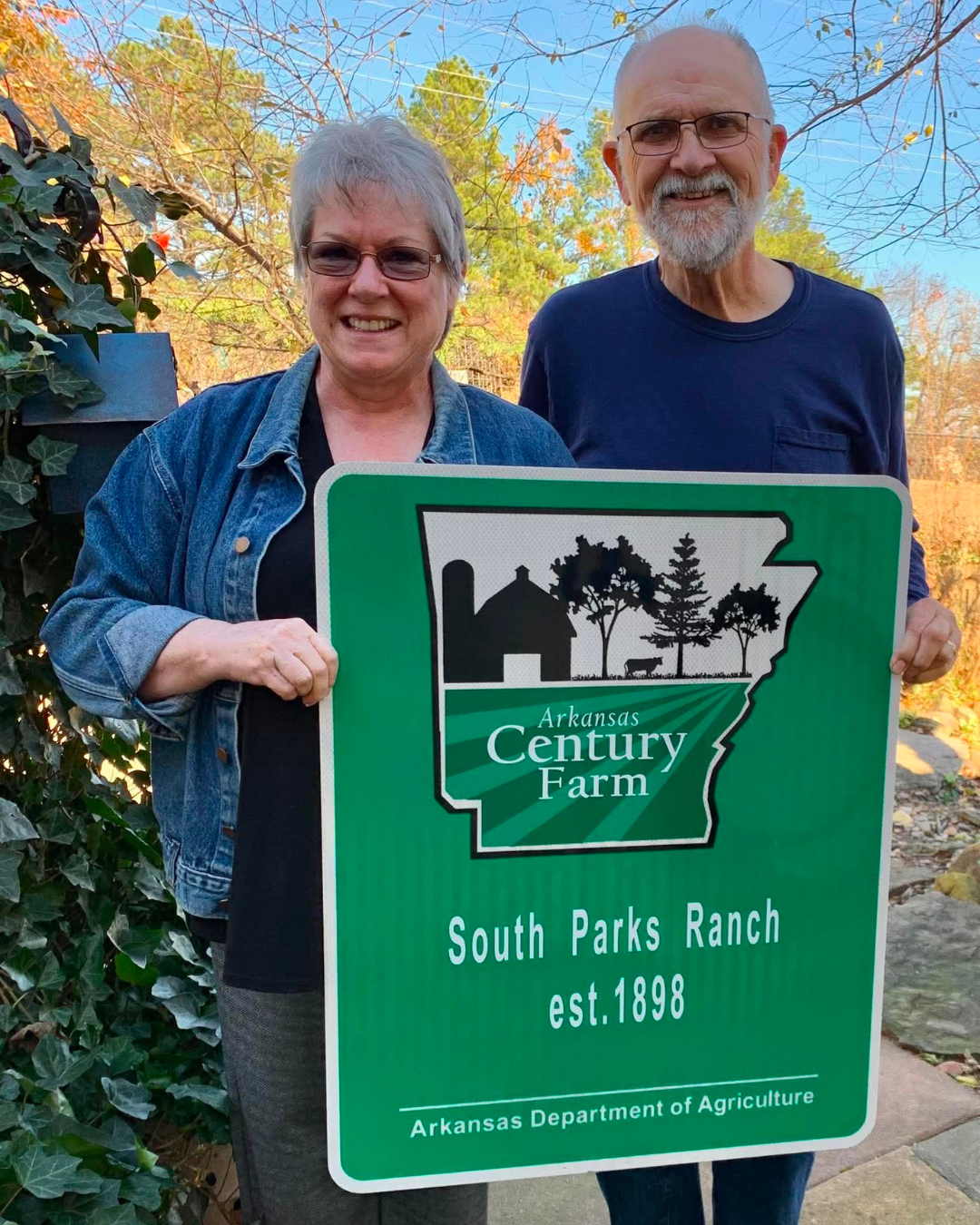
Years later, when I began researching our family's land records and tracing the history of South Parks Ranch, I was reminded just how deeply those lessons were connected to our family story. Discovering the history that supported its recognition as an Arkansas Century Farm was about more than documenting ownership. It was about recognizing generations of responsibility, perseverance, and connection to the land.
I find it extraordinary that I am now preparing to visit a region of Spain where agricultural families have carried similar responsibilities across centuries. The orange groves of Valencia remind me that stewardship is not limited by geography. Whether we are caring for an orchard, a family business, a piece of inherited land, or a lifetime of personal wisdom, we are participating in a responsibility that extends beyond the present moment.
That understanding has influenced the way I approach legacy planning. I believe women must recognize that their lives contain valuable resources beyond their financial accounts and physical possessions. They carry experiences, memories, relationships, practical knowledge, family traditions, and values that deserve to be protected and intentionally shared.
When those things are neglected, a family may lose far more than it realizes. A treasured recipe disappears because no one remembers how it was prepared. A family story becomes distorted because no one recorded the details. An important conversation remains unfinished because everyone assumed there would be another opportunity.
I have experienced enough personal loss to understand how quickly the opportunity to ask questions can disappear. That is one reason I believe so strongly in helping women begin those conversations while they still have time to share their wisdom in their own voices.
Papa probably never imagined that the lessons he taught while working the rocky soil of Arkansas would one day influence a legacy education program serving women far beyond our family. Yet that is exactly what has happened, and I can think of no better illustration of how the seeds planted by one generation may bear fruit in another.
A Suitcase Full of Arkansas and a Heart Ready for Spain
Now, I must confess that all this reflection about roots and heritage has not prevented me from becoming thoroughly absorbed in the more practical details of my upcoming trip. There are travel documents to organize, clothing to select, airline baggage requirements to review, and enough little travel necessities to make me wonder whether my suitcase might need a suitcase of its own.
Since this retreat includes opportunities for professional photographs, I am giving special consideration to the outfits that will accompany me to Valencia. I want to look polished and confident, but I also want to look like myself. After all, there is no reason a Southern woman cannot bring a little elegance and sparkle to a Mediterranean adventure.
I expect there will be a few lovely pieces of Park Lane jewelry tucked carefully into my luggage, along with comfortable shoes for exploring and the practical items that make international travel more enjoyable. I may have to exercise a little restraint when deciding how many accessories are truly necessary, although anyone who knows me understands that restraint and beautiful jewelry are not always the easiest traveling companions.
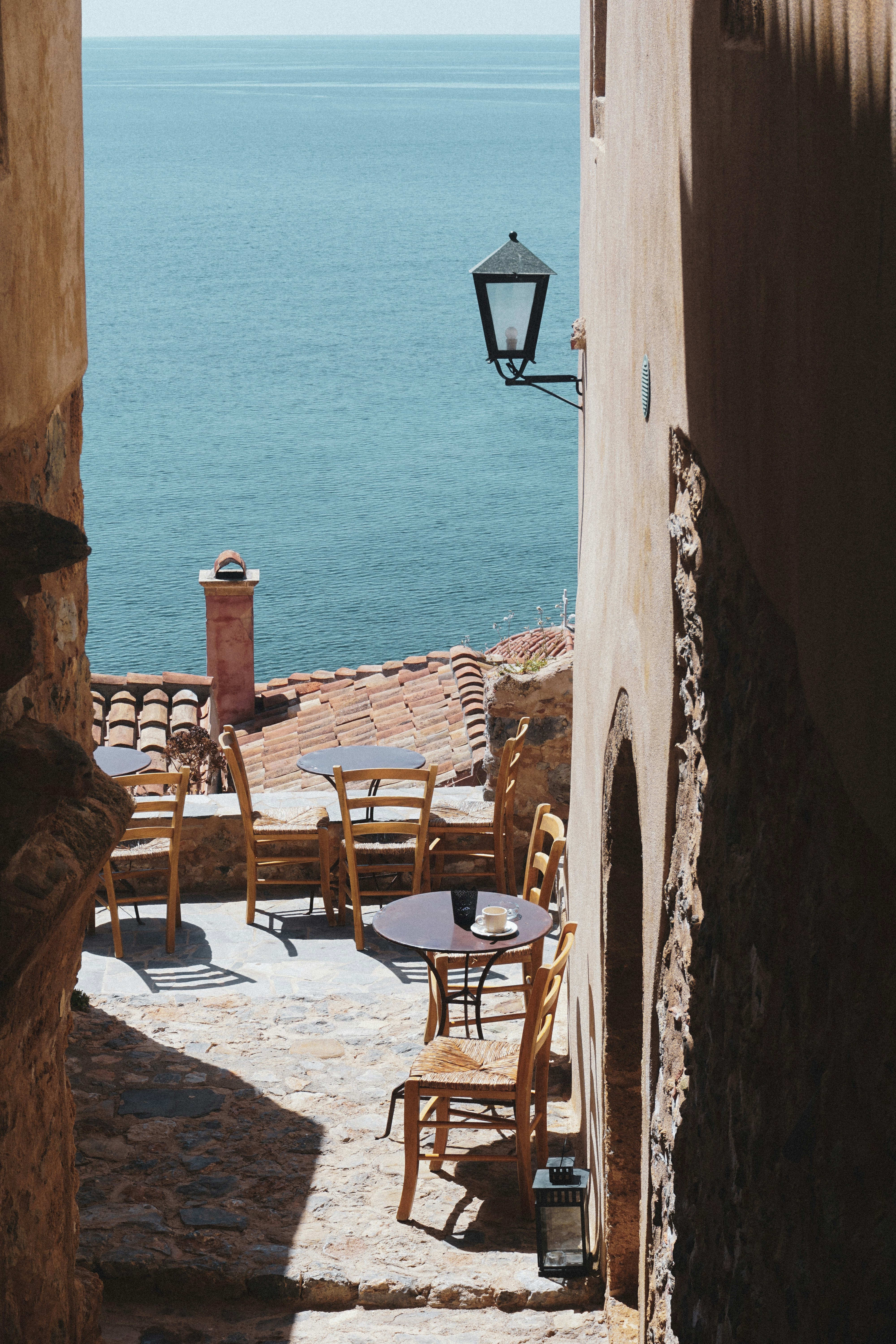
Beyond the packing, I am looking forward to discovering a city whose history reaches back more than two thousand years. I hope to see beautiful old buildings, experience the Mediterranean shoreline, enjoy authentic Valencian food, and perhaps find an opportunity to visit the countryside where orange groves stretch across the landscape.
I am especially intrigued by the thought of tasting traditional Valencian paella in the region where the dish originated. Growing up in the South, I learned that food was never merely about satisfying hunger. It was about family, hospitality, tradition, and the pleasure of gathering around a table with people whose company made the meal memorable.
I suspect the people of Valencia understand that tradition rather well. Their ingredients may be different from those that appeared on my grandmother's table, but the desire to prepare something good and share it with others is a language I have always understood.
And if I happen to find myself enjoying a wonderful meal beneath a Spanish sky, I imagine my thoughts may drift back to those Arkansas days when the greatest pleasures were often the simplest ones. A family gathered together, an afternoon spent outdoors, a familiar voice calling from the house, and the reassuring knowledge that we belonged to a place and to one another.
The Distance Between Where We Begin and Where We Are Going
When I was a young girl growing up down Frost Lane, the world beyond our Arkansas hills sometimes seemed unimaginably far away. My days were filled with familiar faces, ordinary responsibilities, and the sights and sounds of the ranch. I did not know that life would eventually take me into university classrooms, professional leadership positions, international speaking opportunities, and experiences that would introduce me to women from places I had once known only through books and maps.
I certainly could not have imagined that one day I would be preparing to travel to Valencia, Spain, to participate in a retreat focused on building businesses and planning for the future.
Yet the distance between that little girl and the woman packing for Spain is not measured only in miles or years. It is measured in lessons learned, difficulties endured, relationships cherished, and opportunities embraced even when the next step required courage.
There have been times when life felt far more like the rocky soil of Arkansas than a flourishing Mediterranean orchard. There were seasons when the work was difficult, the answers were uncertain, and I had to trust that what I was planting would eventually serve a purpose I could not yet see.
There were also seasons when the fruit appeared in ways I never expected. A student found confidence, a family member carried forward an important lesson, a business opportunity opened a new door, or a woman discovered that her life still held extraordinary possibilities.
Those experiences have taught me that we cannot always predict what will grow from the seeds we plant. Our responsibility is to tend them faithfully, remain open to the lessons of each season, and recognize that meaningful growth often happens long before it becomes visible to anyone else.
As I anticipate Valencia, I am grateful for the opportunities that continue to arrive in this chapter of my life. I am also grateful that the woman preparing for this adventure still carries within her the little girl who once stood beneath an Arkansas apple tree and believed the world was full of things worth discovering.
The Trees We Leave Behind and the Seeds We Carry Forward
There is a tender kind of sadness that accompanies the realization that we cannot return to every place or moment that shaped us. The apple tree at the end of my grandparents' garden belongs to a chapter of life that I carry now through memory. Papa's steady presence, the familiar rhythm of the ranch, and the lessons that seemed so ordinary at the time have become treasures whose value grows clearer with every passing year.
Yet I have learned that leaving a place does not necessarily mean leaving its influence behind. Sometimes the people and places we love become more deeply woven into our lives as the years pass. Their lessons emerge in unexpected moments, guiding decisions and offering comfort when we least expect them.
I imagine that when I see my first orange grove in Valencia, my heart will recognize something familiar beneath all that Mediterranean beauty. I may admire the brilliant fruit, the orderly rows of trees, and the agricultural traditions that have shaped the region, but somewhere in that experience I expect to remember an old apple tree in Arkansas and the people who taught me how to appreciate the gifts of the land.
The two landscapes may look nothing alike, but both tell stories of generations who planted, tended, harvested, and hoped that what they cared for would continue to benefit the people who came after them.
That is the kind of legacy I want to leave.
I want my grandchildren to understand that a meaningful life is not built only through grand accomplishments or public recognition. It is built through faithfulness in ordinary responsibilities, kindness toward others, courage during difficult seasons, and a willingness to keep learning even when we have already traveled a very long road.
I want the women I serve to recognize that their roots are not something they must escape in order to grow. Their experiences, both joyful and difficult, can become sources of wisdom that strengthen their next chapter.
And I want every woman who wonders whether her most fruitful years are behind her to remember that some trees become more beautiful with age, not because every season has been easy, but because they have developed the strength to endure and the capacity to nourish life around them.
From Frost Lane to the Mediterranean, the Journey Continues
As I prepare to close my suitcase and begin this new adventure, I find myself thinking about how far life has carried me from that little garden in Arkansas. The child who watched Papa work behind Bird and the plow could never have imagined all the experiences that would eventually shape her story. She did not know about the degrees she would earn, the students she would teach, the businesses she would build, the family she would cherish, or the losses that would teach her how precious time really is.
She certainly did not know that one day she would be writing about the connection between an Arkansas apple tree and the orange groves of Valencia, Spain.
But perhaps that is one of the most beautiful things about life. We do not have to know the entire journey when we begin. We only have to remain faithful to the lessons entrusted to us, carry our values with integrity, and recognize the opportunities that appear along the way.
I am going to Spain with a heart full of gratitude and a mind eager to learn. I hope to return with fresh ideas for HER Life Legacy™, meaningful relationships with other women, wonderful memories, and perhaps a few photographs that capture the beauty of this new experience.
Most of all, I hope to return with a renewed appreciation for the roots that have made every chapter of my life possible.
For all the differences between Arkansas and Valencia, between the apple tree at the end of our garden and the orange groves growing beneath the Mediterranean sun, I believe they share one enduring lesson. The greatest harvest is not always the fruit we gather for ourselves. Sometimes it is the wisdom we preserve, the love we offer, and the seeds of possibility we leave for those who will come after us.
As for this Southern grandmother, I intend to keep learning, keep traveling, keep planting, and keep finding reasons to be grateful for the remarkable journey God has given me. I may be trading the familiar Arkansas landscape for a Spanish adventure for a little while, but I know exactly where my roots are planted.
And no matter how far I travel, a little piece of Frost Lane will always come along with me.
A Reflection from Frost Lane
As you think about the trees, gardens, farms, and familiar places that shaped your childhood, I invite you to remember the people who taught you how to live. Perhaps there was a grandparent who understood the land, a mother who kept a family together through difficult seasons, or a father whose quiet example taught you the meaning of integrity. Consider the lessons they planted in your life and how those lessons have influenced the woman you have become.
Then ask yourself what you are planting for the generations who will follow you. What stories deserve to be recorded, what values should be explained, and what wisdom might someone need long after you are no longer there to offer it in person? The beautiful thing about legacy is that we do not have to wait until the end of our lives to begin creating it. We are planting its seeds through the choices we make, the conversations we have, and the love we extend every single day.
At HER Life Legacy™, I believe the stories of our lives deserve to be honored and the lessons we have gathered deserve to be shared. We may never know how far those seeds will travel, but we can trust that a life lived with intention has the power to nourish generations we may never meet.
And sometimes, all it takes to remember that truth is an old apple tree at the end of a garden and the promise of orange groves an ocean away.
With love from down Frost Lane,

Dr. Argie Nell Nichols
Founder, HER Life Legacy™
Leadership Educator | Legacy Strategist | Author
Helping women live, love, and die without regret.
